

Backpacks, Bags & Accessories
Which Hunting Backpack to Buy for a Hunt

Oct
The walk out can demand a different pack from the walk in.
At dawn, a compact pack may fit water, spare layers, and essentials neatly. By midday, discarded layers strain its zippers; after a successful shot, meat can overwhelm a shoulder-only suspension. Judge a pack by its heaviest realistic load, not how comfortable it feels empty. For a long pack-out, a supportive hip belt, frame, and load shelf may matter more than organizer pockets.
That capacity has a trade-off. Tall frames can snag in brush or press against a treestand backrest. Where the vehicle is close, a compact pack with good compression may be easier to use all day.
Match the pack to the hunt
-
Time afield and hunting position
A short sit in a stand or blind calls for quiet access to layers and essentials, not necessarily a large bag. Longer days on the move require room for food, water, and changing layers.
Look forA streamlined stand pack for fixed positions; a day pack for mobile hunts.AvoidBulk that catches on a stand or leaves daily gear buried. -
Terrain and access
A short walk to a blind places different demands on a pack than steep, brushy miles. On rough ground, a stable carry and usable hip belt matter more than pockets alone.
Look forA close-fitting pack that stays steady while climbing or ducking under branches.AvoidLoose straps and loads that sway off balance. -
Weather and weapon carry
Rain and cold add bulky layers and make dry storage more important. Rifle and bow carriers should secure the weapon without obstructing movement or slowing retrieval at the hunting position.
Look forWeather protection and a carrier suited to the weapon.AvoidAttachments that snag or block essential pockets. -
Pack-out expectations
If meat may leave the field on foot, check whether the frame, load shelf, and hip belt can carry weight securely. A light stand pack is not automatically a hauling pack.
Look forA load-capable backcountry pack when heavy carries are plausible.AvoidChoosing capacity by bag volume alone.
How much capacity is enough?
Liters describe nominal volume, not how easily bulky gear fits. Use these ranges as starting points:
- 15–30 L: Many day hunts with water, food, rain gear, and a spare layer.
- 30–45 L: Cold-weather day kits or a tightly packed, minimalist overnight.
- 45–70 L or more: Shelter, sleep gear, extra clothing, and several days of food.
Packing style changes the calculation. A thick synthetic jacket takes more space than a compressible down layer, while large exterior pockets may hold items that would otherwise crowd the main compartment. The day-hunt sizing guide can help narrow the range for a particular kit.
Test capacity with the actual gear, not an empty bag. Check that rain gear stays reachable and zippers close without strain. Compression straps can steady a partly empty larger pack, but an undersized pack cannot absorb an unexpected bulky layer or load.

At 25 liters, this TIDEWE pack sits within the typical day-hunt range. Front and interior pockets separate small gear from the main load.
It has padded shoulder straps, an adjustable waist belt, and a reinforced 600D bottom. Bulky cold-weather layers may fill it quickly.
Check fit under a hunting load
A pack that feels comfortable empty can shift badly with meat or overnight gear. Start with torso length, measured from the prominent vertebra at the base of the neck to the top of the hip bones; pack size should match that distance, not overall height. Center the hip belt over the hip bones so it wraps the pelvis rather than cinching the waist.
Check the shoulder straps next. They should follow the shoulders without a gap behind them or a hard downward pull. On a framed pack, load lifters should angle upward from the shoulders to frame anchors above them, drawing the load inward. Anchors below shoulder level cannot do that job, regardless of how tightly the straps are pulled.
Only then assess padding: thick foam cannot correct a short frame or slipping belt. For an adjustment sequence, see the step-by-step fitting process. Test with a realistic load while climbing, crouching, and turning; weight should settle mainly on the hips without bouncing or belt migration. Check that straps and frame do not interfere with shouldering an unloaded firearm or drawing a bow.
Choose for the weight coming out
A soft day pack may carry everything needed on the way in, yet sag when loaded with dense meat. That sag pulls weight away from the back and asks the shoulders to stabilize it. A framed pack offers a stiffer structure for transferring more of that weight to the hips; frame fit still matters more than its advertised volume.
A load shelf places meat between the frame and bag. It can keep meat separate from clothing and food, but only if the shelf is accessible without unpacking everything. Check whether straps compress the load tightly against the frame and whether blood-contact surfaces can be wiped clean. Loose compression lets a compact load shift with each step, especially on sidehills.
For longer carries, compare packs built around heavy pack-outs by frame stiffness, shelf access, and strap layout rather than liters alone. Before leaving the animal, follow a practical meat-packing sequence that keeps portions contained and the heaviest weight close to the spine.
A day pack that cannot haul meat still has a place on a short hunt. The pack-out plan then needs a separate frame, a staged return trip, or another suitable way to retrieve the load. Decide which option is available before the hunt, not after filling the day pack.
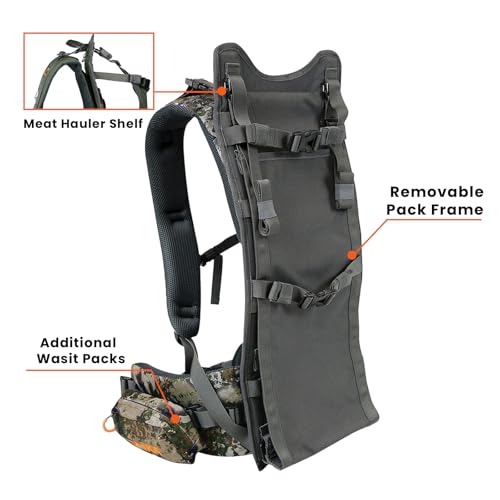
The SPIKA has a removable internal frame, extendable storage, a rifle holder, and a rain cover. Its treated nylon body offers a surface that can be wiped after a messy carry.
The listing does not clearly describe a separate load shelf. Check how meat attaches and compresses against the frame before relying on it for a pack-out.
- Structure
- Removable internal frame
- Storage
- 40L+ extendable
- Body
- 500D treated nylon
- Included features
- Rifle holder, rain cover
Weather protection and noise
A water-repellent finish sheds brief showers; coated fabric provides a stronger barrier, but seams, stitching, and openings can still admit water. Coated zippers resist splashes rather than prolonged runoff, especially where water pools at their ends. A rain cover protects much of the pack body, yet leaves gaps around the harness and can shift in wind. For an all-day forecast, check what a pack’s waterproof features actually protect rather than relying on a single claim.
Pack noise deserves a test with the load and clothing likely to be used afield. Rub the fabric against a jacket, tighten the straps, then open each pocket with gloves on. Stiff fabric may crackle in cold weather; loose zipper pulls can tap the frame, and hard buckles can click against a rifle or bow. Hook-and-loop closures are convenient but conspicuous during a quiet approach. The small fixes that quiet a loaded pack may matter more than its advertised fabric.
Keep electronics, spare insulation, and other moisture-sensitive items in sealed dry bags or waterproof cases inside the pack. A cover protects the bag, not every item within it.
Access without pocket overload
A pocket earns its place when it saves a stop or keeps frequently used gear out of the main compartment. A stretch outer pocket can hold a spare layer, while a hip-belt pocket can keep a wind checker or headlamp within reach. Water needs a bottle sleeve that remains accessible with the pack on, or a hydration hose routed where it will not snag.
More compartments are not automatically more useful. Extra fabric and zippers add weight, and similar-looking pockets make small items harder to find in low light. A consistent system for organizing a hunting pack matters more than pocket count: give each field essential a fixed location and keep seldom-used gear deeper in the bag.
Check access with the pack loaded and gloves on. Optics should come out without brushing against loose straps or hard items; a padded compartment or separate chest harness may suit frequent glassing better than a buried lid pocket. Close each zipper slowly, then walk: pulls, buckles, and loose contents should stay put rather than rattle.
Keep the weapon secure and within reach
A pack-mounted carrier can take weight off the hands during a long approach, but secure transport and quick access are different jobs. A rifle boot or scabbard should hold the stock firmly and keep the barrel clear of straps and brush. Deep, rear-mounted carry may be stable on open ground yet awkward to reach when game appears; a side mount is often faster to release but can snag in tight cover or pull the pack off balance.
Bow carriers need to support the riser without putting pressure on cams, strings, or sights. Exposed limbs and accessories may catch branches even when the bow itself is firmly strapped down. For either weapon, a second retention point can limit bouncing, provided it can be released predictably with gloves on.
Test the complete setup before a hunt: load the pack, attach the actual rifle or bow, then walk, crouch, and turn through brush. Add the layers, binocular harness, and other gear normally worn. Check whether straps loosen, hardware rattles, the weapon strikes the legs, or the release becomes hard to find. If rapid access matters, a dedicated shoulder or front carry arrangement may work better than a tightly lashed pack mount.
Choose the carry system for the hunt
For a long approach with a rifle, prioritize a mount that holds the rifle close to the pack and limits movement at both ends. A secure rifle-carry setup can free both hands on uneven ground, but check whether the rifle remains accessible when the pack is fully loaded. A holder that works on an empty pack may become awkward once side pockets and compression straps are in use.
For bowhunting in brush, the choice shifts toward a low-snag bow-carry setup. Look for secure contact points that keep limbs and accessories from projecting far beyond the pack. External cradles and extra straps can help stabilize a bow, but they also add bulk and more places for branches to catch. Walk through tight cover with the bow mounted before committing to that arrangement.
If a heavy pack-out is realistic, favor a frame with a load shelf that can hold dense weight close to the back. That capability brings frame weight and hardware on every outbound mile, even when the shelf stays empty. A lighter day pack may make more sense when meat will be retrieved separately.
In every case, start with torso fit and enough capacity for the actual gear list. Then test the mounted weapon and expected load together: attachment features cannot compensate for a shifting hip belt, an overfilled bag, or an unstable load.
YVLEEN includes rifle and bow holders, making it worth checking for hunts that alternate between the two weapons.
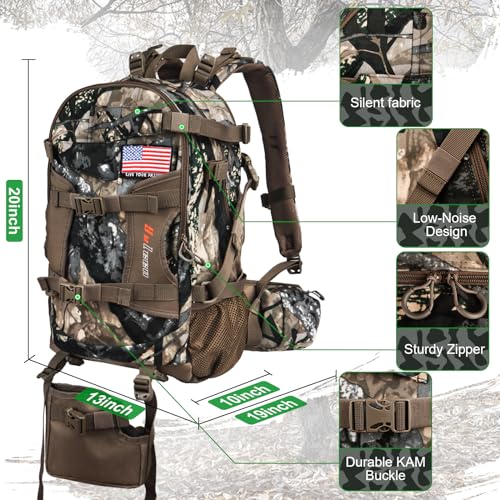


Before buying, load each shortlisted pack with the gear it would carry on the hunt. Walk at a normal pace, climb and crouch, then retrieve frequently used items without unpacking. Check whether a secured rifle or bow clears the head, arms and brush; listen for strap slap, squeaks and noisy closures.
A pack that passes those trials under a realistic load is a stronger candidate than one that looks well equipped on an empty showroom rack.
