

Blog
Pick Your Trail Power: Nomad 10 vs Nomad 5 Tested
May
Torn between more range or less weight—will the Nomad 10 save your trip when power fails, or will you miss the freedom and lightness of the Nomad 5?
You want reliable trail power without lugging heavy gear. Our head-to-head of NOMAD 10 vs NOMAD 5 shows which tiny solar champ charges your phone faster, survives the bumps, and keeps camp lights glowing so you stay powered and worry-free.
Basecamp Power

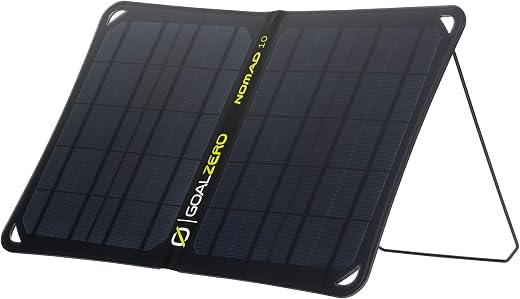
You get a higher-output panel that takes the sting out of long days off-grid. It’s built tough so you won’t worry about tossing it in your pack, but you’ll feel the weight compared to ultra-light options.
Pocket Power
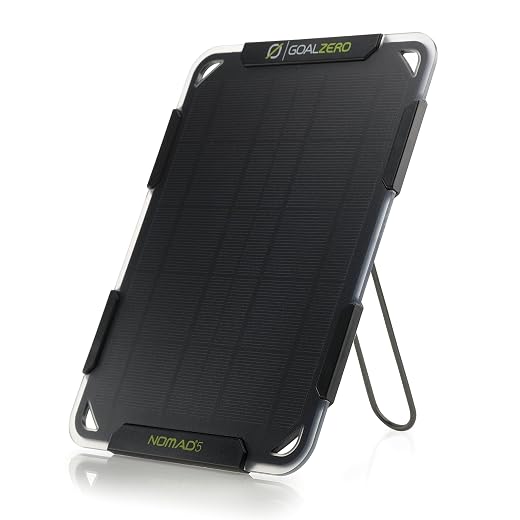
You’ll love how little extra weight this adds to your pack and how easy it is to clip on and forget about. It won’t charge big power banks quickly, but it soothes the worry of dead devices on short trips.
Goal Nomad 10
Goal Nomad 5
Goal Nomad 10
Goal Nomad 5
Goal Nomad 10
Goal Nomad 5
Carry & Camp: Portability, Size, and Durability
Pack weight & fit
You carry everything on your back—every ounce matters. The Nomad 10 is a real tool: it folds flat, snaps closed, and has a beefy feel that still straps to most packs without flopping. The kickstand helps you angle it to chase sun while you hike or break camp.


The Nomad 5 almost disappears on your pack. It’s tiny, light, and frees up space for food and extra layers. That’s perfect for day hikes or ultralight trips. The trade-off: fewer watts when clouds roll in, so you’ll wait longer for a full charge.


Ruggedness & trail toughness
Build quality matters when rain, mud, and slips are real risks. The Nomad 10 uses thicker materials and a heft that handles rough treatment—drops, tight zippers, and wet group packs make it sweat less. The Nomad 5 is durable for light use but can feel fragile if you toss it into a muddy, crowded pack or slam it in a zip pocket. Also watch that the USB port on both isn’t fully waterproof—keep it tucked away in bad weather.
Feature Comparison
Power Performance: Real-World Charging & Sun Tricks
Sun power in real life
When your phone dies you feel cut off. The Nomad 10 delivers higher wattage, so in strong sun it charges faster — you can top a phone or trickle a battery pack while you stand on a sunny ridge and soak in the view. The extra watts mean less sitting around waiting and less worrying about a dead device at night.

Clouds, angle, and ease
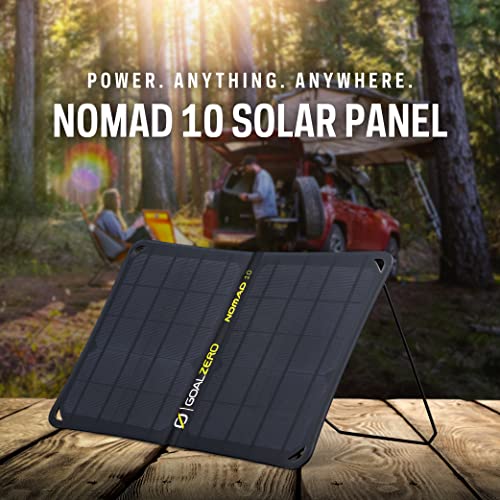
The Nomad 5 gives slower but useful juice. It’ll save you if you forget a charger or drain your battery after a long day. Clouds hurt both panels, but the Nomad 10 holds more output in dim light. Angle matters: point the panels at the sun and keep them clean. Nomad 10’s kickstand and foldable design make angling easy. Nomad 5 is simpler — you’ll move it more to chase sun patches.


Plug, pair, and plan
Both are plug-and-play via USB — phones, headlamps, GPS, and small cameras work without adapters. Pair either with a power bank and you get day-into-night power, which removes the panic of dying batteries. Think about how many devices you bring and how many nights you’re gone: Nomad 10 eases overnight anxiety; Nomad 5 is a calm companion for short trips.
User Experience & Value: Which One Fits Your Style?
Feel & use
You want gear that just works when the sun shows up. The Nomad 10 feels more professional — solid USB port, snug build, and a sturdy kickstand that stays put when you angle it. It gives faster charging, so you spend less time waiting and more time moving. The Nomad 5 is simple and light: slip it into your pack, pull it out in a sun patch, plug in, and go. No fuss.
Money, weight, and peace of mind
Price and weight matter when you’re miles from help. The Nomad 10 costs more and takes a bit more space, but that extra weight buys reliability on longer trips. If losing a charged phone keeps you up at night, the Nomad 10 soothes that worry. The Nomad 5 is cheaper and cheerful — perfect if you hike light, do day trips, or want a backup for weekends.
Quick pick guide
Think about your worst-case day on the trail and choose the panel that lets you relax and sleep better.
Final Verdict: Which One Fits Your Trail?
Clear winner: Nomad 10 — pick it if you want steady, reliable charging on multi-day trips and calm nights. It kills battery panic and keeps your lights on. Bring it, seriously, always.
Choose Nomad 5 when ultralight carry, low cost, or a no-fuss emergency booster matter more. Ready to ditch panic and hike longer?

Long weekend trip report:
Took both Nomad 10 and Nomad 5 to test which stayed in my pack. Kept the 10 on camp for charging a small battery bank and the 5 clipped to my daypack for quick top-offs.
Result: 10 = camp charger, 5 = opportunistic charger. Wouldn’t carry both on a short trip unless I really needed redundancy. Also, the 10’s USB felt firmer than the 5’s port (minor but noticeable).
We tested them side-by-side in the article but didn’t parallel. From what I read, you need special hardware to safely combine outputs — not worth the risk unless you know what you’re doing.
Thanks, Priya — useful layout. Also that loose port note made me lol because I hate fiddly connectors mid-hike.
Thanks for the field report, Priya — that’s the kind of practical split-use scenario we wanted to highlight.
Good idea to mix roles. I might adopt that strategy for overnight trips.
Correct — paralleling USB outputs without proper circuitry can cause issues. We avoided that in our tests.
Weird question: did you ever have both out at once in full sun? Wondering if they can be paralleled for faster charging.
Just bought a Nomad 5 after reading the post. Mini update: it fit perfectly in my sling bag and charged a nearly-dead phone while I was out birdwatching. Quietly impressed.
Haha ok this is half-serious: if you’re into minimalism and also melodramatic about battery anxiety, get the Nomad 10 and feel like a tiny solar deity at camp. 😆
But on a practical note, the 5 is perfect for folks who want “set it and forget it”.
Exactly. Personal aesthetic aside, both have their place.
Lol love that. Solar deity vibes, indeed.
Solar deity or not, function wins for me. 10 when I need output, 5 as backup.
Fun visual — tiny solar deity is now a tagline I want to use. 😄
Nomad 5 for the win if you just want something tiny to top off your phone on a day hike. I keep one in my camera bag, barely notice the weight.
I’ve been using the Nomad 10 for over a year. Random thoughts:
– The USB port is sturdier than cheap panels.
– It’s a bit pricey but I like the brand reliability.
– One time it filled my 10,000 mAh bank to ~70% in a sunny afternoon.
Also side note: keep the panel clean — dust kills performance more than you’d think.
Great long-term perspective, Daniel. Dust/soiling is a sneaky performance killer — we wiped panels between runs in the review.
Did you ever have connector issues? Those ports worry me on long trips.
Folded and padded between layers. Treat it like a fragile book.
Tape hack = genius. Going to try that.
No connector failures yet. I use a small bit of tape over the port in dusty camps.
How do you pack it? Fold or slide it between clothes?
Final thought: check return policies. I swapped mine after realizing the 5 just didn’t give me enough trickle. Local store made it easy, YMMV.
Good practical advice. Returns can save you a lot of buyer’s remorse.
Yep, bought online and kept the packaging just in case. Smart move.
Interesting test. I was surprised the Nomad 5 didn’t keep up as well when I clipped it to my backpack while hiking. Seems placement and angle matter more than I expected.
Try mounting it higher on the pack or on a hat/wide strap. Angle = everything.
Exactly — backpack placement often creates shading from straps, trees, or your own body. Hard to measure but it showed up in our field numbers.
Quick Q: which one survived a tumble? I tend to clumsily drop stuff. 😅
Nomad 10 felt more robust due to size and thicker casing. Nomad 5 is delicate by comparison — fine for careful users, less forgiving if you toss it around.
I want to add something technical: the panel’s output drops fast with angle misalignment. The adjustable kickstand on the 10 is legitimately useful for optimizing angle when you’re at camp. Also, thermal throttling can happen on super hot days — let it breathe.
Exactly. Elevated and ventilated is best.
Good technical note — angle and heat both matter. We included a small diagram showing optimal tilt.
Heat? Never thought of that. So don’t lay it directly on hot rocks?
Is there an easy way to monitor output while it’s charging? I don’t want to guess.
A cheap USB multimeter works great to see amps/volts in real time.
Okay I have a long-ish take:
I bought the Nomad 10 last summer and used it for weekend backpacking. It charges my phone from 20% to 80% in a few hours of good sun. The panel folds nicely and the USB port is convenient. BUT —
– If you’re doing ultralight thru-hikes the Nomad 5 makes sense because every gram matters.
– Cloudy days: both suffer, but 10W still gives a better trickle.
– Price vs use: if you only need emergency top-ups, the 5 is cheaper and less regretful lol.
So pick based on how often you’ll actually use full-day solar. Personal preference really.
Yes Priya — always a small power bank. Solar charges the bank during the day, then I charge devices at night. Keeps the schedule flexible.
Totally agree. I sold my heavy gear when I realized I only used it twice a year.
Great summary, Laura. The cloudy-day point is key — peak output drops fast. We added a note in the article about worst-case cloudy amps.
Do you carry a battery pack too? I feel like solar + battery = sanity on longer trips.
We recommend pairing the panels with a small battery pack for reliability. Mentioned that in the ‘real world’ tips section.
Short and sweet: 5 for city use, 10 for actual outdoor adventuring. If you live near reliable sun, go 10. If you’re mostly urban, save cash.
Nice rule of thumb — we used a similar framing in the buyer’s guide section.
Value check: is the Nomad 10 worth the extra money over the 5 if you only hike on weekends? Curious what others think.
If weekend trips are your only use, the 5 might be fine. But if you often need meaningful charge (powering cameras, charging a battery fast), the 10 is worth the premium.
Depends on how impatient you are haha. I like faster charging at camp so I picked the 10.
I’m weekend-only and went with the 5. No regrets — cheap insurance for phone battery.
I’m torn. I hike with kids so weight + ease-of-use matters. The Nomad 5 seems kid-proof (small, light), but the 10 might actually charge the camera faster when we stop. Anyone tried charging a GoPro with these?
GoPros usually take a steady 1-2A. The Nomad 10 can do a better job in full sun. 5 will top off slowly but sometimes that’s enough.
If kids are involved I vote Nomad 5 for less to worry about. But bring a battery for the camera.
Tried Nomad 10 with a GoPro Hero 8 — on a long sunny day it got a good trickle. Not fast enough for continuous filming, but great for recharges at camp.
Or use the 10 for camp and keep the 5 in the daypack as backup. Best of both worlds 👍
Loved the hands-on comparison. For me the Nomad 10 hits the sweet spot — 10W feels noticeably faster for my phone and small power bank. The kickstand is surprisingly sturdy on uneven rocks. A bit bulky for ultralight packs though.
Agree on the kickstand. I usually duct-tape a twig to prop things up but that goal zero one saves time 😅
Thanks Emily — glad the kickstand detail helped! We noticed that too: better positioning makes a big difference in output.
Do you get decent output in partial shade? That’s my biggest worry.
I wrote a long checklist before picking a model and this article helped. A few more personal notes:
– The 10’s weight is noticeable after a day but not a dealbreaker.
– The 5 is great for casual use and as an “I forgot to charge my phone” solution.
– If you’re trying to replace a power bank entirely, neither is perfect alone; combo needed.
Hope this helps someone on the fence.
Great checklist approach, Samantha. We tried to make the article actionable — sounds like it worked for you.
Solid tips. I carry a small battery anyway so the panels are more like helpers than main power sources.