

Emergency Supplies
Pressure Bandage vs. Tourniquet: What the Myths Get Wrong About When Each Is Needed
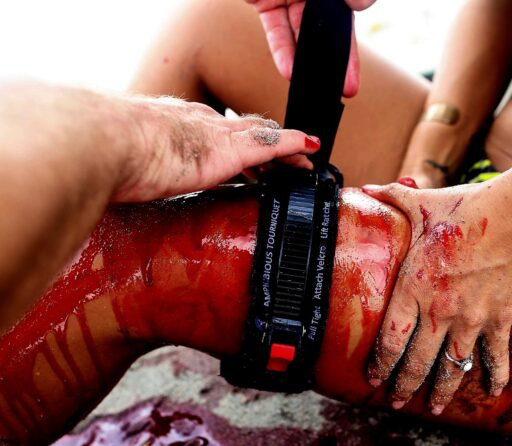
Nov
The location of the wound matters as much as the amount of blood.
A responder opens a kit to find both an elastic pressure bandage and a tourniquet while blood is spreading across a sleeve. The first question is where the bleeding starts. A tourniquet is designed to stop severe bleeding from an arm or leg; it is not a solution for wounds on the torso, neck, or where a limb joins the body.
The next question is whether firm pressure is controlling the bleeding and can be maintained. A pressure bandage can help hold that pressure in place, but it should not delay escalation when limb bleeding is life-threatening or remains uncontrolled. Heavy, continuous bleeding, blood that spurts, or rapidly soaked dressings warrant immediate emergency help—even while the injury is being assessed.
Why location determines whether a limb tourniquet can work
They control bleeding differently. A pressure bandage holds compression against a wound; a limb tourniquet tightens around an arm or leg to restrict blood flow toward an injury.
A bandage acts at the bleeding site. A tourniquet acts above it, so the two are not interchangeable.
A standard limb tourniquet is intended for an injured arm or leg, not the torso or neck.
It needs a limb it can encircle and compress. Wrapping one around the chest, abdomen, or neck cannot reproduce that mechanism and could cause serious harm.
Bleeding at the junction between a limb and the torso may leave no usable space for a standard limb tourniquet above the wound.
These junctional areas have different constraints from injuries farther down an arm or leg. Their bleeding may require wound-focused compression or specialized measures rather than an ordinary limb tourniquet.
Why the bleeding response matters as much as the device
Bleeding that responds to direct pressure is different from life-threatening limb bleeding that continues despite it.
A pressure bandage can maintain effective wound compression once bleeding is controlled. A limb tourniquet addresses a different problem: bleeding severe enough that wound pressure is not controlling it.
A bandage can hold pressure, but it cannot compensate for inadequate compression or bleeding that remains uncontrolled.
Blood continuing to soak through or flow heavily signals that the initial approach has not controlled the hemorrhage. Uncontrolled bleeding is an emergency regardless of which supplies are available.
Design and reliability matter when selecting a tourniquet for a kit, but equipment choice cannot overcome an unsuitable wound location.
Even a purpose-built limb device depends on a place to encircle the limb above the injury. Torso, neck, and many junctional wounds lack that anatomy.
Must a pressure dressing always come first?
For life-threatening bleeding from an arm or leg, waiting to see whether a dressing works can delay control. A tourniquet may be appropriate without a dressing-first trial.
A bandage maintains pressure at the wound; a tourniquet restricts blood flow upstream. They are not interchangeable steps in a mandatory sequence.
A dressing may be overwhelmed by rapid bleeding, particularly when sustained, effective pressure cannot be maintained.
Pressure must reach the bleeding site and remain firm. Movement, difficult access or competing demands can make that impractical despite an available bandage.
Continued heavy bleeding signals that the current approach is not controlling it; adding layers can also obscure what is happening underneath.
The important question is whether bleeding has stopped, not how many dressings have been used. Uncontrolled severe bleeding warrants urgent emergency response.
Does a dressing replace a working tourniquet?
A bystander should not routinely loosen or remove an effective tourniquet. Stopping visible bleeding is the intended result, not a signal to test the wound.
Releasing pressure can restart severe hemorrhage, including bleeding that a newly placed dressing may not control.
Tourniquet conversion is a deliberate reassessment performed by clinicians or appropriately trained responders under suitable conditions.
It requires judging whether the wound can be controlled by other means while monitoring closely for renewed bleeding.
A dressing may cover or protect the wound without taking over the tourniquet’s job of restricting upstream flow.
The absence of visible blood while the tourniquet is tightened does not show that a dressing alone would work.
An effective tourniquet buys time for emergency care; it does not resolve the injury. The application time, if known, is useful information for responders. A bystander’s priority is emergency escalation and observation for renewed visible bleeding—not periodic loosening to “restore circulation.”
What determines the choice?
- Wound location A limb tourniquet is designed for an arm or leg; it cannot compress bleeding in the neck, chest, abdomen, or groin.
- Bleeding severity Catastrophic limb bleeding may call for a tourniquet without first testing a dressing. A less severe wound may be controlled with sustained direct pressure and a pressure bandage.
- Pressure response A bandage that becomes soaked or fails to maintain firm pressure has not controlled the bleeding. The response matters more than how substantial the dressing looks.
The myth is that the stronger-looking device is automatically the right one. Location, bleeding severity, and whether pressure controls the wound are more useful distinctions. A tourniquet addresses severe bleeding from a limb; a pressure bandage helps maintain compression where pressure is effective.
Neither device replaces emergency care. Hands-on bleeding-control training and familiarity with kit contents matter more than carrying equipment whose use is unfamiliar.
